



What is a first home buyer home loan?
A first-time buyer home loan is no different from any other home loan as a product. You'll still need to pay a deposit, borrow the remaining balance of the property price from a lender and then repay that debt with interest and fees in set instalments throughout your loan term.
As a first-time buyer, however, you may have access to rebates and government support programs, which aren't available to existing buyers or investors.
Home loan jargon explained for first-time buyers
Given you’re in the process of looking to buy your first home, there’s a good chance that, between speaking to a real estate agent or mortgage broker, you’re going to come across a few terms you’ve never heard before.
- Borrowing power: an estimate of how much you may be able to borrow based on your current financial profile. Your lender will give you an idea of this figure when you get pre-approved for your loan. You can also use Savvy’s borrowing power calculator to find out an estimate of what your borrowing power may be before applying.
- Comparison rate:a percentage figure that combines a loan's interest rate with most of its fees and charges into a single number, giving borrowers a truer picture of what the loan actually costs. While the interest rate alone tells you how much you'll be charged to borrow the money, the comparison rate also factors in things like application fees and account-keeping charges, so two loans with the same interest rate can still have different comparison rates.
- Deposit:a lump sum you’ll need to provide as a contribution to the purchase price of your home. Most lenders require 20% of the purchase price to avoid paying lenders mortgage insurance (LMI), but first home buyers may be able to pay as little as 5% or even 2% in certain circumstances.
- Interest-only (IO) loan: a type of home loan whereby the borrower only pays the interest due on the loan for an initial set period (typically between one and five years) and doesn’t make any repayments towards the principal sum borrowed. This is most commonly used by investors.
- Lenders mortgage insurance (LMI): an insurance premium that borrowers may have to pay if they can’t provide a 20% deposit. This protects the lender in case of loan default and can amount to thousands of dollars, although there are ways around paying LMI even if you don’t have a 20% deposit (which we’ll discuss a bit further down).
- Loan-to-value ratio (LVR): a percentage figure that describes how much money you want to borrow compared to the value of the property you want to buy. For example, if you pay a 20% deposit on your home purchase, that means the LVR is 80%.
- Principal: the actual amount of money you borrow from the lender to buy your home, not including interest or fees.
- Principal and interest (P&I) loan: this is a standard home loan. Your loan repayment consists of both the interest due on the loan and a small amount of the sum you originally borrowed. As time goes by, interest decreases and a larger portion of each repayment goes towards paying off your principal.
- Split loan: one portion of the loan has a fixed interest rate and the remaining portion has a variable interest rate. The borrower can choose which portion of their mortgage is fixed and variable (commonly 60/40 or 70/30).
- Stamp duty: a state-based tax on the price of buying land. First home buyers can get reductions and exemptions in many states. If not, it can amount to tens of thousands of dollars.
Why apply for a home loan with Savvy
First home buyer schemes, grants and cash incentives
Most states and territories in Australia have rebate and incentive schemes for first home buyers, as well as several programs that are available Australia-wide. These include:
Australian Government 5% Deposit Scheme
The Australian Government 5% Deposit Scheme, formerly known as the First Home Guarantee, is a program that allows eligible first-time buyers to pay as little as 5% as a deposit without being charged LMI by their lender. Single parents and legal guardians may be eligible with as little as 2% deposit.
In the 2024-25 financial year, more than one in three first home buyers nationally were supported by the scheme (then known as the First Home Guarantee), according to Housing Australia.
The scheme now has unlimited places available and no upper limit on your income.
The types of property you can buy are:
- Existing house, townhouse or apartment
- House and land package
- Off-the-plan apartment or townhouse
- Vacant land with a separate building contract
This program is only available for properties that are purchased under the approved price caps for each state and territory, which the Australian Government updated in October 2025. These caps are as follows:
Australian Government Help to Buy Scheme
The Australian Government Help to Buy Scheme is a new initiative launched in December 2025. It is a shared equity scheme that allows eligible buyers to purchase a home with a deposit as low as 2%, with the Government contributing:
- Up to 40% of the purchase price for a new build
- Up to 30% for an existing home
The Government’s share must eventually be repaid at market value, either through incremental repayments, a lump sum or when you sell the property.
For example, if you buy a $1 million home in Sydney and the Government takes a 30% share, its stake is initially worth $300,000. If the property rises in value by 20% before you sell, that 30% share would then be worth $360,000.
Help to Buy has tighter availability and eligibility rules than the 5% Deposit Scheme, with limits on both places and income:
- 10,000 places are available each year
- Income caps are $103,000 for individual applicants and $165,000 for joint applicants or single parents
Applicants must also be Australian citizens, unlike other schemes, which also allow permanent residents to apply.
Property price caps broadly align with the 5% Deposit Scheme, although there are some differences. The Help to Buy cap for Sydney and eligible NSW regional centres is $1.3 million, compared with $1.5 million under the 5% Deposit Scheme. In the Northern Territory, the cap is $600,000 across the board, with no higher limit for Darwin.
First home super saver (FHSS) scheme
The FHSS scheme allows eligible first-time buyers to make voluntary superannuation contributions which can then be used towards their deposit. You can contribute up to $15,000 per year and up to $50,000 overall via this scheme.
The main benefit is that concessional contributions are taxed at a rate of 15%, which is much lower than standard tax rates outside of super. On top of this, any assessable FHSS amounts are subject to a 30% tax offset.
According to the ATO, when you’re ready to buy your home, you can withdraw the following:
- 100% of your eligible personal voluntary contributions you haven't claimed a tax deduction for (non-concessional contributions)
- 85% of your eligible salary sacrifice contributions (concessional contributions)
- 85% of eligible personal voluntary super contributions you have claimed a tax deduction for (concessional contributions)
- An amount of associated earnings on both concessional and non-concessional contributions
If you’re considering using the FHSS scheme, it’s worth investigating it further or speaking to an accountant or tax professional to determine whether it’s right for you.
First Home Owner Grant (FHOG)
Each state and territory has its own FHOG, with the exception of the ACT. Here’s the breakdown of what it looks like where you live:
Stamp duty concessions
On top of the FHOG, eligible first-time buyers can also receive an exemption from, or reduction to, their payable stamp duty. Here’s how that looks in each state or territory:
How much do I need for a deposit as a first home buyer?
Most lenders require a deposit of at least 20% to avoid paying lenders mortgage insurance (LMI), an extra cost that protects the lender if you can't make your repayments.
But 20% isn't a hard rule, and as a first home buyer, you may have several ways to get into the market with a smaller deposit, some of which avoid LMI entirely, even below that threshold.
Below are some examples of what different deposit situations could look like for a $500,000 home purchase, paid off with a 30-year loan at 5.50% p.a.
Scenario #1: paying a 20% cash deposit
The most straightforward solution, a 20% deposit will meet all lenders’ requirements and spare you from having to fork out for LMI. It also means your loan will be smaller at just $400,000 (80% LVR) in this situation. In this case, you’d be paying $1,048 per fortnight and $417,221 in interest overall.
Scenario #2: paying a 10% cash deposit and LMI
If you aren’t in a position to reach the 20% deposit mark or take advantage of any other programs, you’ll likely be forced to pay LMI. Not only would your fortnightly loan payments and total interest rise to $1,179 and $469,374, respectively, with a 10% deposit, but you’d also have to deal with a potential LMI bill of over $8,000.
Scenario #3: paying a 5% cash deposit with the First Home Guarantee
Being approved for the FHG means you won’t have to worry about LMI and can be approved with a deposit of just 5%. In this scenario, that’s just $25,000 cash. With a $475,000 loan, you’d be paying $1,244 per fortnight and $495,450 in total interest. It’s important to note that because of the smaller deposit through FHG, you’ll have to show that you can still afford to service the loan.
Scenario #4: paying no cash deposit with a guarantor
The last option is applying with a guarantor, aka the bank of Mum and Dad. This is usually a parent or grandparent who has enough equity in their property to act as partial security for 20% of your loan. Depending on your lender and your guarantor’s financial profile, you could be approved for a loan worth 100% of your property’s value. In this situation, your fortnightly repayments would be $1,310 and your overall interest bill would be $521,526. No LMI is payable on a guarantor loan.
First home buyer tips

Budget is king
"Buying your first home isn’t just about the numbers; it's about strategy. The right home loan sets the foundation for your financial future. First-time home buyers will often overlook expenses like stamp duty, LMI and moving costs, which can really stack up.
Find out what incentives or schemes you can utilise, how much you should aim to contribute as a deposit and how to decrease unforeseen overheads.
Most importantly, get pre-approved! You’ll know exactly what your budget is and can search for your dream home with confidence."

Building inspections can save your bacon
"When I was buying my first home, I put in an offer on an older house that was accepted, subject to a building and pest inspection.
I sought out a licensed operator to carry out the inspection, who found a range of red flags that a regular person like myself couldn’t have picked up on. Because of the clause in the contract, this was enough for me to back out of the deal without any financial pain.
While it’s hard to get your deposit together, keeping enough funds aside for a check like this undoubtedly saved me tens, if not hundreds, of thousands of dollars in the long run."

Don’t sleep on offset accounts
"When my partner and I were applying for our home loan, we had two main priorities: we wanted a competitive interest rate and an offset account. I had run the calculations long before we found our house and saw just how much we could save with even a relatively modest amount in the bank.
So, when we did eventually find the place that was right for us, we were straight in for the offset package. Our lender allowed us to create unlimited accounts, so we essentially moved all our banking over and created nominal transaction, savings and joint accounts.
Because neither of us put in 100% of our savings, we were able to throw the amount left over into our accounts and reduce the total interest we’d have to pay by over $100,000. That could make a huge difference when it comes to buying our forever home."
How to apply for a home loan as a first-time buyer
-
Apply online
Fill out our online form with all the necessary details.
-
Send documents
Supply your broker with the required documentation.
-
Speak to us
Talk with your broker and personalise your loan to your needs.
-
Conditional approval
From there, pre-approval allows you to shop within your budget.
-
Secure your home purchase
Once you've found it, lock in your first home of choice.
-
Formal application and approval
Your broker will guide you through the process, from formal application to full approval.
-
Settlement
Once everything's signed off, you’ll officially be a first home buyer!
First home buyer statistics: 2026
Borrower activity
- The average first home buyer is now 33 years old, according to CommBank.
- 60% of first home buyers now purchase with someone else, whether a partner, friend or family member, rather than buying alone.
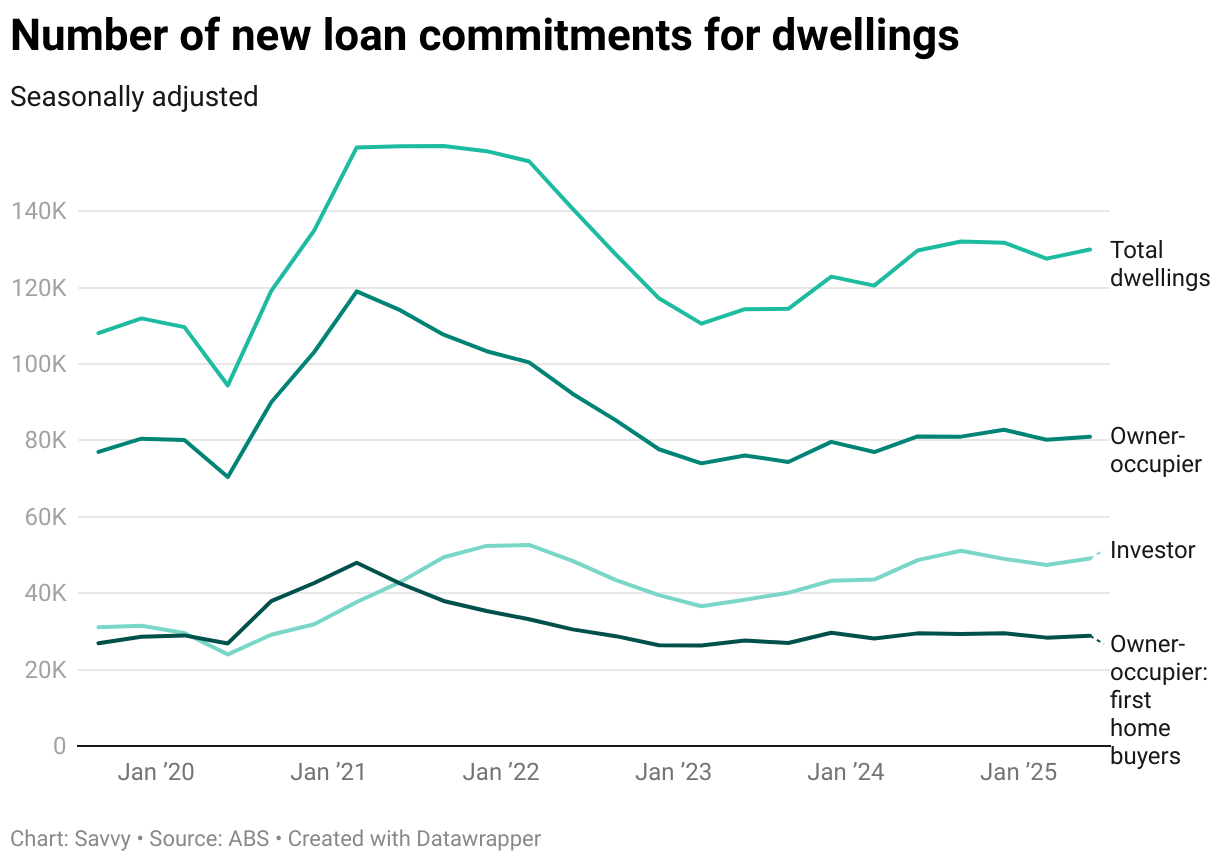
- First-time buyers took out 29,319 home loans in the June 2026 quarter, according to the latest ABS lending indicators. That's down 2.9% on the March 2026 quarter, though unchanged from the same time last year.
- Despite fewer loans overall, first home buyers borrowed more money in total. The value of these loans reached $18.4 billion in the June 2026 quarter, up 0.2% on the previous quarter and 10% higher than a year earlier.
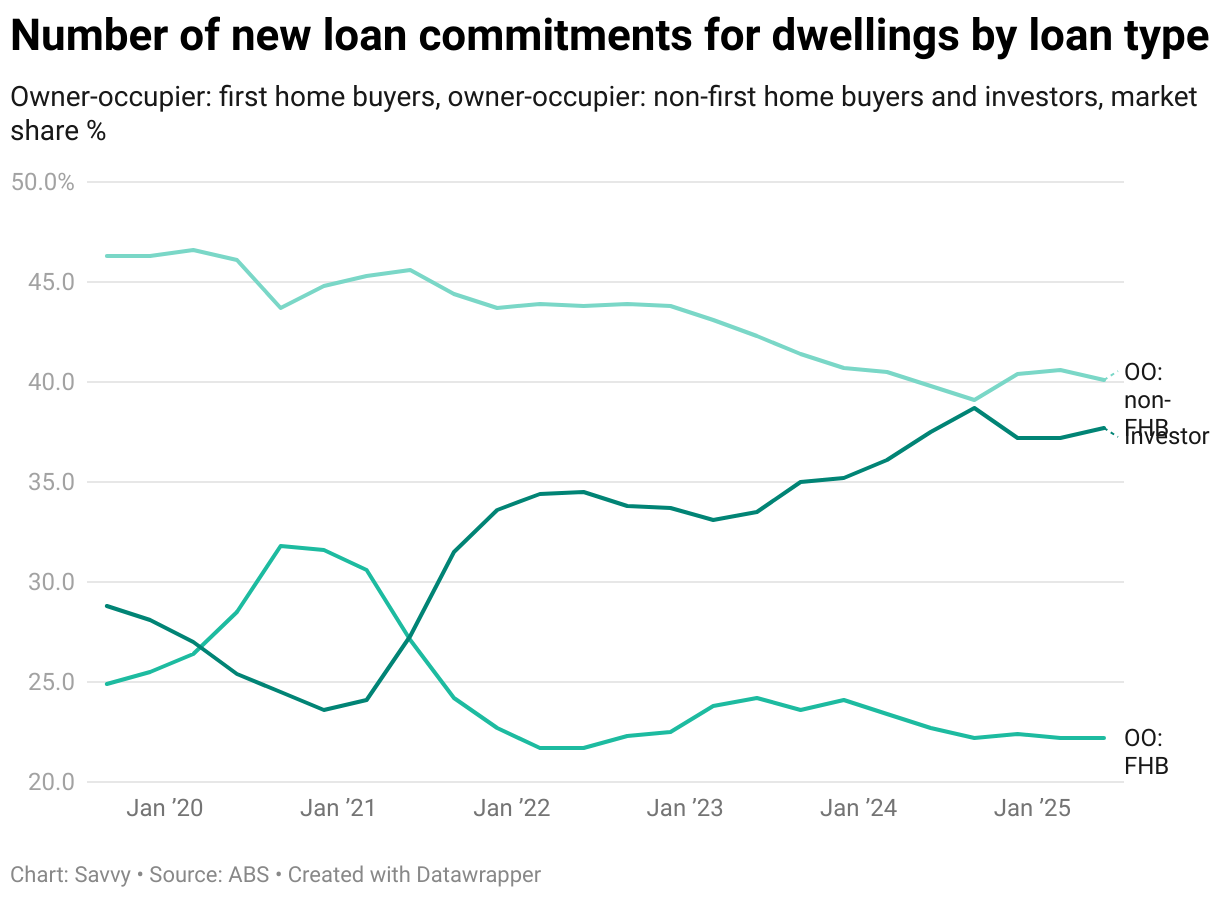
- First home buyers accounted for 35.9% of all owner-occupier home loans in the quarter, and 21.8% of every home loan approved in Australia, including those taken out by investors.
Saving a deposit
- On average, it now takes 3 years and 6 months to save for an entry-level unit, 5 years to save for an entry-level house and 11 years and 11 months to save for a median-priced house in Australia, according to data from Domain and Cotality.
- Sydney is the slowest capital for an entry-level house, taking 7 years and 7 months to save a deposit, nearly double the time needed in Darwin, the fastest capital at 4 years.
- For units, Brisbane has now overtaken Sydney as the capital where it takes longest to save an entry-level unit deposit, at 4 years and 11 months. Again, Darwin remains the fastest capital, taking just 2 years and 7 months to save a unit deposit.
- In every capital, buyers generally need to save for two to three times as long to afford a median-priced house compared to an entry-level one.
Help from family
- According to Finder's 2026 Home Loan Report, 30% of homeowners, around 1.8 million people, received financial help from family to buy a home.
- 11% received a contribution towards their deposit, 8% had their home paid for outright by family, 6% had a family member act as guarantor on their loan, 5% had their entire deposit covered, 5% received help with ongoing mortgage repayments and 3% received a lump sum above what was needed for the deposit.
- Two-thirds of Gen Z buyers received some form of family help to buy their home, compared with just one in ten Baby Boomers.
Housing supply, affordability and intentions
- 26% of first home buyers say a lack of listed properties is holding them back, up 14 percentage points since 2019, according to Westpac's March 2026 Home Ownership Report.
- 39% point to competition from other buyers as a barrier, up 8 points since 2019.
- 74% of first home buyers are now willing to purchase in a location they hadn't originally considered, according to Westpac's August 2026 Home Ownership Report.
- Intention to buy a house has fallen from 64% in 2021 to 53% in 2026, while interest in apartments (17% to 29%) and townhouses (7% to 19%) has grown sharply over the same period.